

Identity Alignment & Realignment:
The Key to Human Adaptability in an Ever-Changing World
Identity matters •
Identity matters •


Understanding the human side of change
Understanding the human side of change
In a world of relentless disruption, performance isn’t just about skills — it’s about identity. When who we are, what we do, and where we belong fall out of sync, trust erodes, clarity blurs, and both people and organisations lose their footing.
Identity Alignment & Realignment offers a framework for understanding and navigating these moments — turning uncertainty into a catalyst for evolution rather than collapse.

The Identity Realignment Cycle
The Identity Realignment Cycle (IRC) maps how people, teams and organisations move through disruption, make meaning and return to alignment.
It’s a human-centred model of adaptability — revealing what really happens beneath change: why disruption destabilises, what burnout or imposter syndrome often signal, and how meaning, belonging and performance can be restored.
The Cycle helps us recognise where we are in the process of change — and respond with awareness, alignment and agency, rather than resistance.
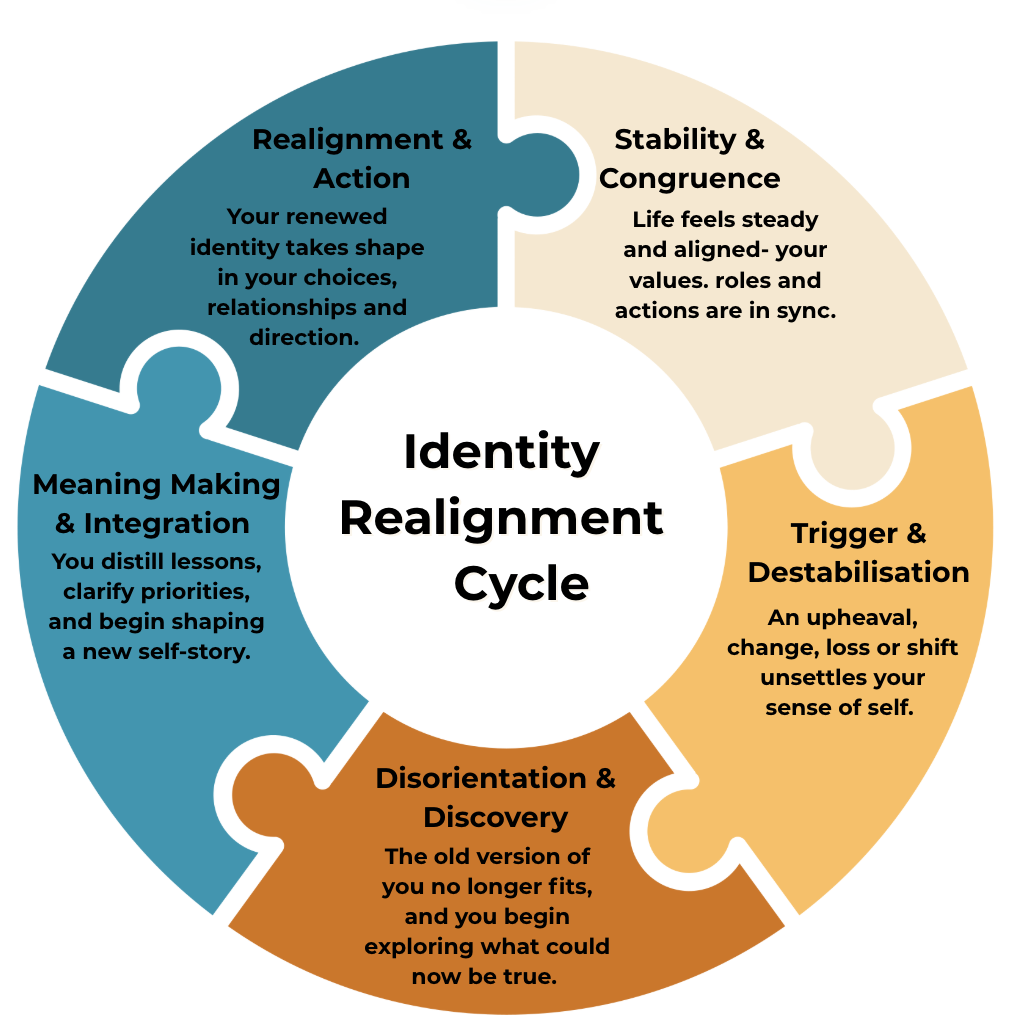
The Identity Realignment Cycle illustrates the emotional and cognitive terrain we traverse when our sense of identity is disrupted. It shows that change isn’t a straight line but a repeating rhythm — from stability to disruption, reflection, renewal and back into aligned action.
The power of the model lies in recognising where we are within that rhythm, so we can respond with awareness instead of resistance. It reminds us that disorientation isn’t failure — it’s part of the process that makes deeper alignment, growth and coherence possible.
Stability & Congruence
This is where identity feels steady and aligned — values, roles, and actions flow in harmony. Confidence, clarity and connection are strong. Yet this phase isn’t static; it’s the point from which growth begins.
Focus for growth: Reinforce the foundations that create stability — purpose, belonging, and shared understanding. Recognise what gives energy and coherence before change arrives.
Trigger & Destabilisation
Something shifts — a change in role, structure, relationship, or belief — unsettling what once felt certain. Old strategies stop working, and identity starts to wobble.
Focus for growth: Name the disruption without rushing to fix it. Identify what remains true, what’s being tested, and where safety and stability can be rebuilt.
Disorientation & Discovery
The familiar story begins to dissolve, and questions arise: Who am I now? What matters most? While uncomfortable, this is the phase of possibility. Curiosity and experimentation start to replace control.
Focus for growth: Create psychological safety for exploration. Encourage reflection, dialogue, and small, low-risk experiments that open space for new insight.
Meaning-Making & Integration
New patterns of understanding start to emerge. Lessons are distilled, values clarified, and coherence slowly restored. This is the critical phase — the turning point that determines future direction. Here, meaning becomes the compass that guides decisions, behaviours and collective culture moving forward.
Focus for growth: Reflect and share meaning through dialogue. Translate learning into new principles, shared language, and aligned priorities that reconnect purpose and performance — setting the stage for sustained alignment and evolution.
Realignment & Action
Clarity and confidence return as identity and context click back into sync. Energy flows again, but this time from a deeper understanding of self and system.
Focus for growth: Embed alignment through consistent behaviour, feedback and structure. Strengthen trust, belonging, and purpose so that when the next disruption comes — as it always does — the cycle begins from a stronger foundation.
Always in Motion
Everyone — every team, every organisation — is always somewhere in this cycle. Misalignment is inevitable. Realignment is always possible.

Identity Realignment reminds us that growth doesn’t come from avoiding disruption, but from moving through it consciously.
When we understand the patterns beneath change, we gain the clarity and courage to evolve — becoming more connected, more capable, and more human in how we live, work and lead.

Professional relevance for organisations, teams, and individuals
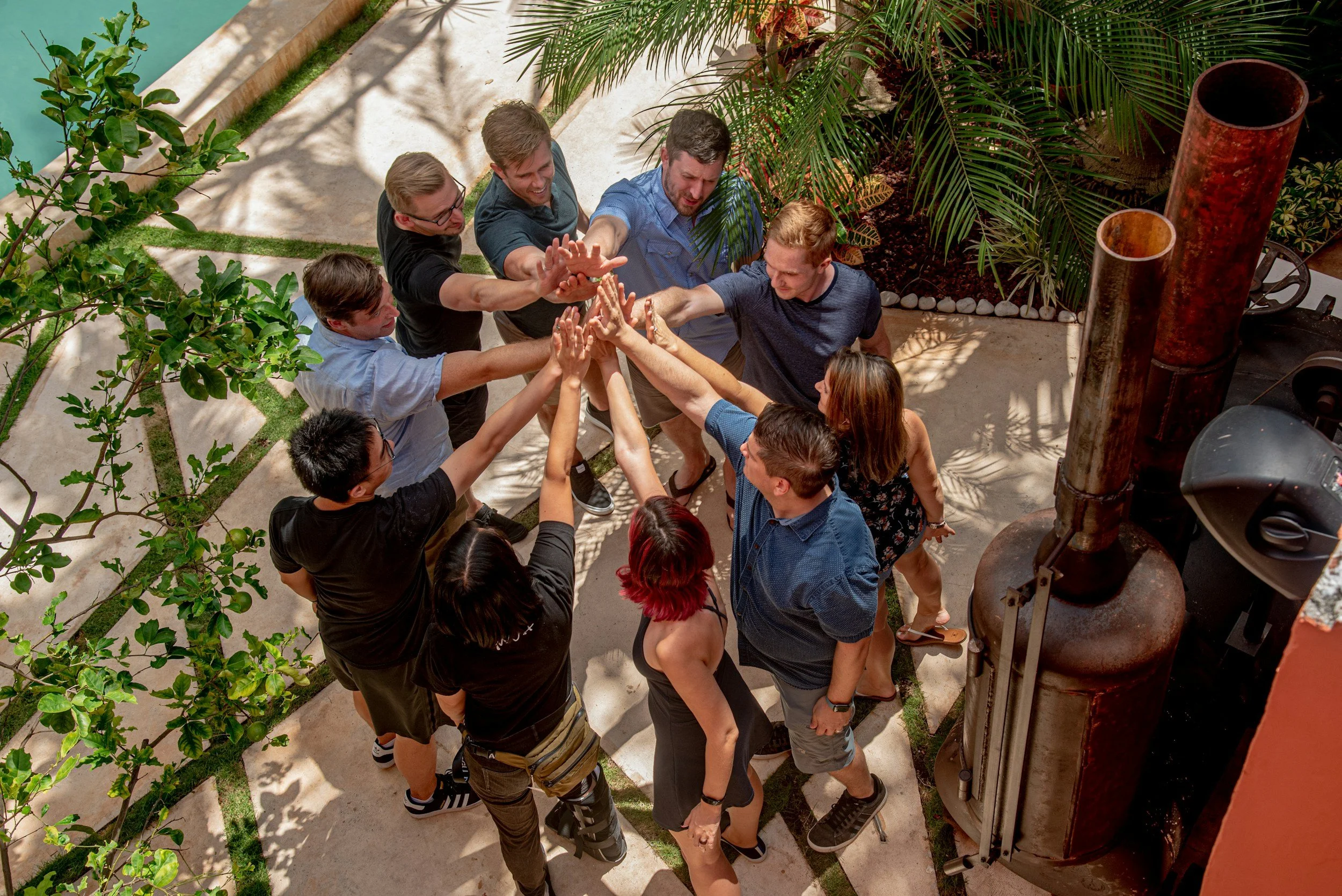
Identity Realignment transforms how people and systems respond to change. For organisations, it strengthens the foundation of culture — trust, belonging and adaptability — creating teams that can navigate disruption with confidence and integrity. Leaders gain a clearer lens for understanding human behaviour and aligning people with purpose, while individuals learn to move through uncertainty without losing coherence or direction.
Together, they create workplaces where alignment drives both wellbeing and performance.


Relevance for schools: Leadership, teachers, and students
In education, Identity Realignment helps leaders, teachers and students understand the inner process of learning and growth. School communities experience constant change — in curriculum, culture, and identity — and this framework supports each layer of that transformation.
For leaders, it fosters clarity and connection in complex systems; for teachers, it deepens engagement and wellbeing; and for students, it builds the self-awareness and resilience they’ll carry long after graduation.

Relevance for daily life
Identity Realignment isn’t only for organisations — it’s a lens for life. It helps us understand the cycles of change we all experience: moments of disruption, disorientation and renewal. By learning to realign who we are with what matters most, we cultivate stability and meaning even in uncertain times.
This awareness fosters stronger relationships, clearer choices and a grounded sense of purpose — helping us live with more coherence, compassion and courage.

How I’ve Lived and Learned This Work
My life has always been a living exploration of adaptability and meaning.
From managing a remote outdoor education centre in the Australian wilderness — accessible only by flying fox and long before modern conveniences reached that valley — to raising a toddler and giving birth to my second child by firelight, I learned early that resilience isn’t built through comfort, but through connection, purpose and creativity.
That same curiosity carried me across the world — from teaching in Vietnam to leading schools in South Korea and the United States. In Seoul, I was responsible for crisis planning in the event of a North Korean invasion — a role that taught me calm is not the absence of fear, but the ability to stay grounded in uncertainty. Each experience expanded my understanding of identity and culture, and how people find belonging in changing landscapes.
-
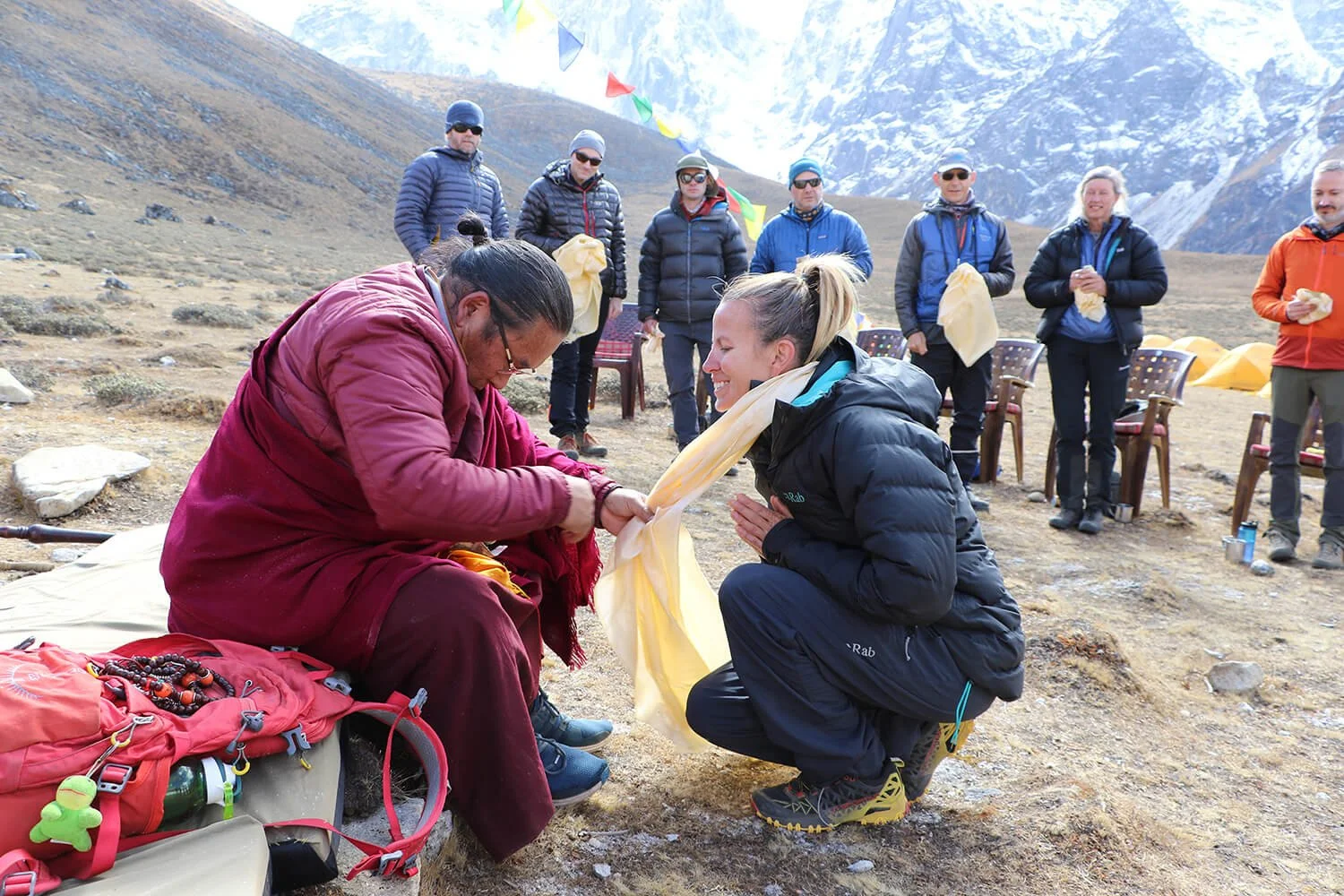
In my fifties, living with Multiple Sclerosis, I turned my attention to the ultimate test of adaptability — climbing above 8,000 metres on Mount Everest.
What began as a physical challenge became a deeper inquiry into human potential: how identity holds under pressure, and how meaning anchors us when control is stripped away. Even when I turned back shy of the summit, I came home with something more valuable than a peak — insight into how people rebuild coherence, courage and clarity after disruption.Through it all — the wilderness, the classrooms, the boardrooms and the mountains — one thread has remained constant: a fascination with what drives us to evolve.
My life has been my greatest case study in identity, belonging and performance — the human side of adaptability.That lived experience now underpins everything I teach, research and share — helping others navigate their own realignments with clarity and purpose.
Jen's journey with Multiple Sclerosis (MS) is a testament to her unwavering determination and positive outlook. Following her diagnosis, she turned this personal challenge into a mission, raising over $90,000 for MS research and her expedition costs combined. Her dream of climbing Mount Everest was fuelled by this drive, and although she had to turn back at 8,000 meters due to logistical issues, Jen saw this not as a failure but as a profound learning experience. Her ability to view setbacks as opportunities for growth underscores the power of her adventure mindset.
Jen’s story is a powerful testament to the impact of an adventure mindset. Her journey inspires others to approach challenges with a strong mind and a light heart, demonstrating that with the right mindset, anything is possible. With her dynamic experiences and relentless spirit, Jen brings a unique perspective to every endeavour, making her an invaluable partner for those looking to achieve extraordinary success.